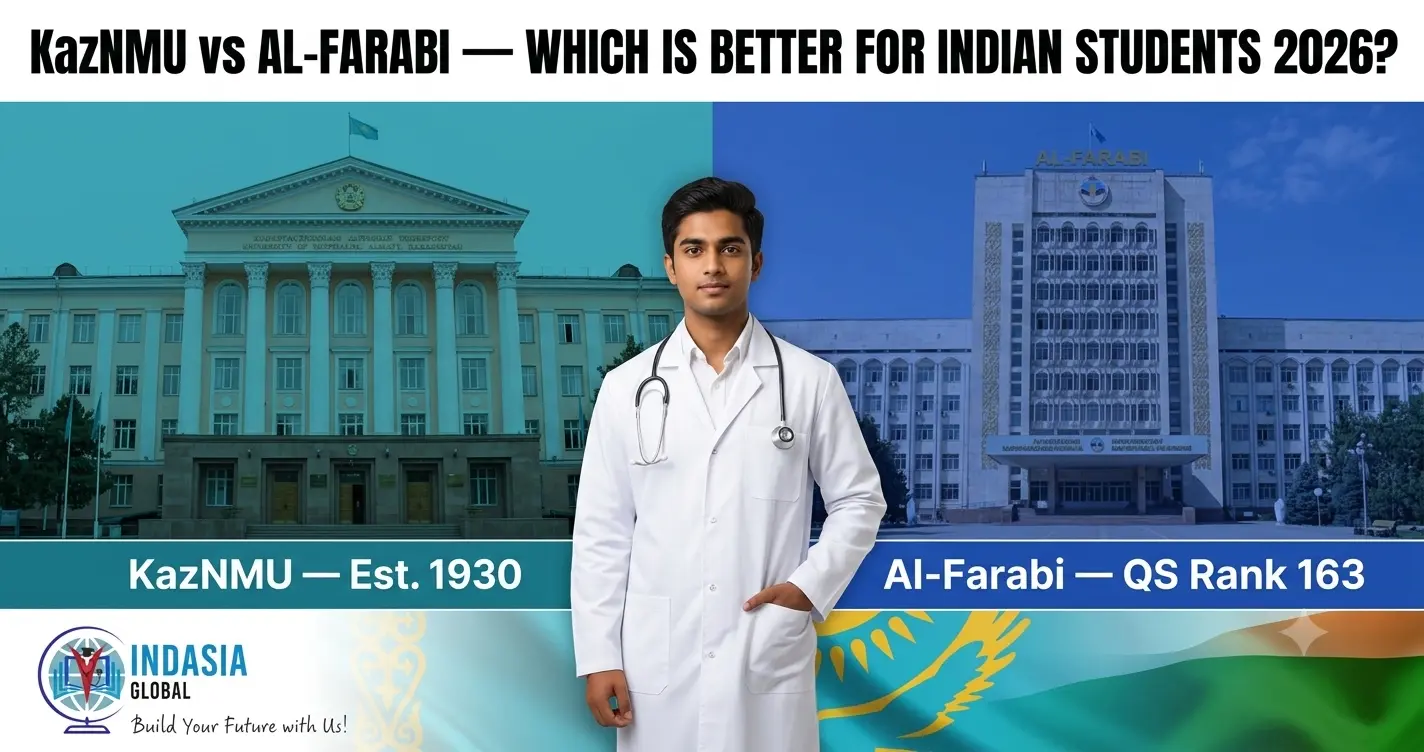
If you have already decided on Kazakhstan for MBBS and specifically on Almaty as your city of choice, the next decision is the most important one you will make for your medical career: KazNMU or Al-Farabi?
Both universities are in Almaty. Both are NMC-approved and WHO-listed. Both offer English-medium MBBS programs. But they are fundamentally different institutions with different strengths, different FMGE track records, different fee structures, and different campus environments. Making this choice based on vague advice or proximity alone is a mistake.
This guide is written with genuine insider knowledge — Dr. Tara Chand Nehra, who heads Indasia Global’s resident team in Almaty, is himself a KazNMU alumnus who completed his MD there. His team has direct, first-hand experience with both universities from the student support side. This is not a generic comparison — it is grounded in what Indian students actually experience at both institutions.
KazNMU (Asfendiyarov Kazakh National Medical University) — At a Glance
Founded: 1930 — the oldest medical university in Central Asia Type: Dedicated medical university Location: Central Almaty QS Ranking: Not ranked in global QS (specialized medical institution) NMC / WHO Status: Approved and WDOMS listed FMGE Pass Rate: 20 to 30 percent country-level average; KazNMU alumni consistently perform above Kazakhstan’s national average Annual Tuition: Approximately Rs 3.5 to 5 lakhs per year Indian Students: Thousands currently enrolled — one of the largest Indian student populations in Kazakhstan
KazNMU is a dedicated medical university — every faculty member, every hospital, every resource is focused exclusively on medical education. It owns and operates three teaching hospitals directly attached to the university campus, giving students consistent clinical access from Year 3 onward. The university has been training Indian doctors since the 1970s and has alumni across India, the Middle East, and internationally.
Al-Farabi Kazakh National University — At a Glance
Founded: 1934 — one of Kazakhstan’s oldest classical universities Type: Comprehensive research university (medicine is one of many faculties) Location: Almaty (different campus from KazNMU) QS World Ranking: 163rd globally in QS 2026 — Kazakhstan’s highest-ranked university NMC / WHO Status: Approved and WDOMS listed FMGE Pass Rate: 51.08 percent in 2024 — the strongest FMGE performance of any Kazakhstan university in recent years Annual Tuition: Approximately Rs 4 to 6 lakhs per year (slightly higher than KazNMU) Indian Students: Growing population, smaller than KazNMU but well established
Al-Farabi is Kazakhstan’s premier research university. Its QS rank of 163 globally in 2026 makes it the most internationally recognized university in the country. The General Medicine faculty (MBBS) is one of many faculties within a larger university ecosystem that includes engineering, law, sciences, and social sciences. This multi-disciplinary environment differs fundamentally from KazNMU’s medical-only focus.
The FMGE data for Al-Farabi is the most compelling figure in this comparison. A 51.08 percent pass rate in 2024 means roughly half of Al-Farabi’s graduates cleared the licensing exam in that year — significantly above KazNMU and above the national average of approximately 25 percent. This is not a one-year anomaly — Al-Farabi has been a consistent top performer in Kazakhstan for FMGE outcomes.
Side-by-Side Comparison — The Factors That Matter
| Factor | KazNMU | Al-Farabi |
|---|---|---|
| Founded | 1930 | 1934 |
| Type | Dedicated medical university | Comprehensive research university |
| QS Global Ranking | Not ranked (specialized) | 163rd globally (2026) |
| FMGE 2024 Pass Rate | Above country average (~25%) | 51.08% — Kazakhstan’s best |
| Annual Tuition | Rs 3.5–5 lakhs | Rs 4–6 lakhs |
| 6-Year Total Cost | Rs 28–33 lakhs | Rs 32–38 lakhs |
| Teaching Hospitals | 3 own hospitals, directly attached | Affiliated hospitals (not owned) |
| Indian Student Community | Very large — decades of history | Growing — well established |
| Campus Environment | Medical-only focus | Multi-disciplinary university |
| Clinical Exposure | Strong from Year 3 — own hospitals | Good — affiliated teaching hospitals |
| International Recognition | NMC, WHO, WDOMS | NMC, WHO, WDOMS, QS ranked |
Which University Should You Choose — Honest Guidance
Choose KazNMU if: Your budget is tighter (Rs 28 to 33 lakhs total) and you want a dedicated medical environment where every resource is focused on clinical training. KazNMU’s own hospitals provide consistent, structured clinical exposure. The very large Indian student community means you will never be isolated, and peer support networks are exceptionally strong. Dr. Tara Chand Nehra himself graduated from KazNMU — which means Indasia Global’s Almaty team knows this university inside out, from faculty expectations to hostel logistics to clinical rotation schedules.
Choose Al-Farabi if: Your priority is FMGE and NExT outcomes, and your budget can accommodate the slightly higher fees of Rs 32 to 38 lakhs total. The 51 percent FMGE pass rate in 2024 is the strongest data point for any university in Kazakhstan, and for a family whose primary concern is that their child returns to India and clears the licensing exam, this number matters enormously. The QS global ranking also gives Al-Farabi stronger international recognition for students who may consider postgraduate options in India, the UAE, or internationally.
The honest truth: Both universities are strong choices that have produced thousands of practicing Indian doctors. The decision between them is not about which is “good” versus which is “bad” — it is about which profile fits your family’s priorities better. Budget-conscious families with community support as a priority tend to prefer KazNMU. Families who are willing to pay a modest premium for the best FMGE track record in Kazakhstan choose Al-Farabi.
A Note on Fees — What the Numbers Actually Mean
The fee difference between KazNMU and Al-Farabi is approximately Rs 3 to 5 lakhs over 6 years in tuition, plus slightly higher living costs at Al-Farabi due to university and campus differences. This is not a trivial difference for most families.
However, consider the FMGE outcome difference. A student who attends a university with a 20 percent pass rate and takes 2 or 3 attempts to clear NExT has spent additional time and money on coaching, accommodation, and exam fees. A student who attends a university with a 51 percent pass rate and clears in one attempt has saved years and several lakhs in post-graduation costs. The fee difference may justify itself in FMGE outcomes alone.
Frequently Asked Questions
1. Which university has a better FMGE pass rate, KazNMU or Al-Farabi? Al-Farabi had a 51.08 percent FMGE pass rate in 2024, the highest of any Kazakhstan university. KazNMU performs above the Kazakhstan national average of approximately 25 percent but lower than Al-Farabi. Both are strong by country standards.
2. Is Al-Farabi more expensive than KazNMU? Yes, slightly. Annual tuition at Al-Farabi is approximately Rs 4 to 6 lakhs versus Rs 3.5 to 5 lakhs at KazNMU. Total 6-year cost including living expenses is approximately Rs 32 to 38 lakhs at Al-Farabi versus Rs 28 to 33 lakhs at KazNMU.
3. Which university has better clinical exposure? KazNMU owns and operates 3 teaching hospitals directly on or adjacent to campus, providing structured and consistent clinical access from Year 3. Al-Farabi uses affiliated teaching hospitals, which are good quality but involve students traveling to different hospital sites.
4. Is Al-Farabi a better university because of its QS ranking? For MBBS purposes in India, NMC recognition and FMGE outcomes matter more than QS rankings. Al-Farabi’s QS rank of 163 globally is impressive and gives it stronger international recognition, but KazNMU’s clinical infrastructure and 90-plus year medical-only track record are equally valuable for MBBS training.
5. Which university has a larger Indian student community? KazNMU has a significantly larger Indian student community, built over decades. Al-Farabi’s Indian population is growing but is currently smaller. For students who prioritize a large peer support network, KazNMU has the advantage.
6. Can Indasia Global help with admission to both KazNMU and Al-Farabi? Yes. Indasia Global has established relationships with both universities and our resident Almaty team can assist with admission to either. We make recommendations based on each family’s budget, priorities, and profile — not on which university offers us a higher commission.
Still deciding between KazNMU and Al-Farabi? Contact Indasia Global for free counselling. Our resident team in Almaty has direct, first-hand experience with both universities — from admission to daily student life. Visit our Jaipur office or call us for a detailed comparison based on your specific profile and budget.