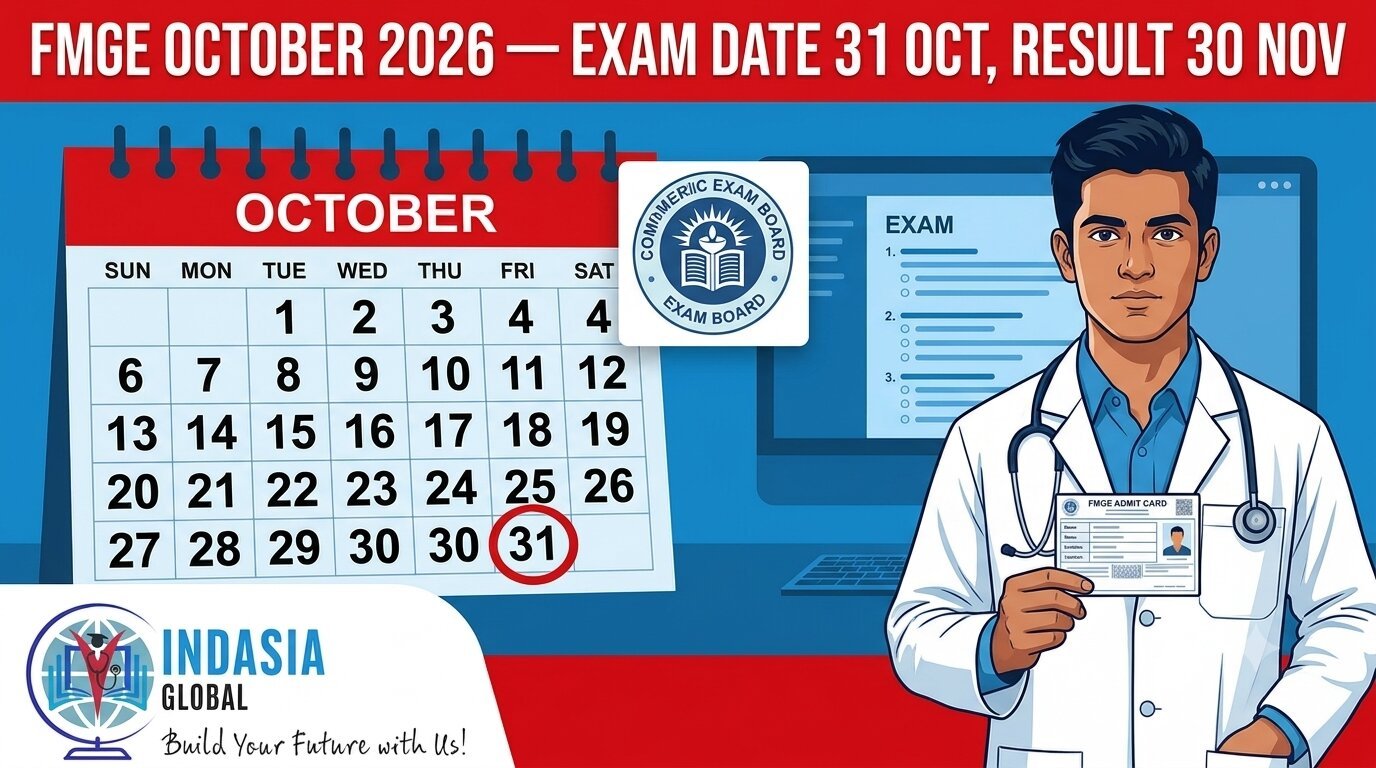
The FMGE October 2026 session is scheduled for October 31, 2026 — just days away. This is only the second time in FMGE history that a third session has been announced in a calendar year, making it a significant opportunity for Indian students who completed MBBS abroad and are waiting to begin practicing in India.
This guide covers everything about FMGE October 2026 — dates, eligibility, pattern, how to prepare in the days remaining, and the critical steps after you pass.
FMGE October 2026 — Key Dates
<cite index=”127-1″>The National Board of Examinations in Medical Sciences (NBEMS) will conduct the FMGE October 2026 exam on October 31, 2026.</cite> Here are all the important dates:
| Event | Date |
|---|---|
| Registration window | September 11 – September 25, 2026 |
| Final edit window | October 3 – October 19, 2026 |
| City intimation slip | October 20, 2026 |
| Admit card release | October 27, 2026 |
| FMGE Exam Date | October 31, 2026 |
| Result expected | November 30, 2026 |
Registration for this session is now closed. If you registered, your admit card will be available from October 27 at natboard.edu.in.
Why a Third FMGE Session in 2026 Matters
<cite index=”126-1″>The Foreign Medical Graduate Examination is now moving to up to three sessions a year, with an additional 31 October 2026 session announced. On 28 August 2026 NBEMS decided to hold FMGE three times a year.</cite>
This change is significant for Indian students who completed MBBS abroad. Previously, with only two sessions per year (June and December), a failed attempt meant waiting 6 months for the next opportunity — effectively losing half a year before starting internship and practice. With three sessions, the gap between attempts reduces to approximately 4 months, which meaningfully reduces the career delay for students who need more than one attempt.
FMGE Exam Pattern — What You Are Facing on October 31
<cite index=”133-1″>To qualify the exam, the candidate must score 150 marks (50 percent) out of 300.</cite> The exam is computer-based and consists of 300 MCQ questions across all medical subjects — the same subjects covered in the Indian MBBS curriculum.
The exam is divided into two papers of 150 questions each, typically conducted in two sessions of 2.5 hours each on the same day. All questions are single-best-answer MCQs. There is no negative marking.
The subject distribution follows the NMC’s Indian MBBS curriculum — Pre-clinical subjects (Anatomy, Physiology, Biochemistry), Para-clinical subjects (Pathology, Pharmacology, Microbiology, Forensic Medicine), and Clinical subjects (Medicine, Surgery, Paediatrics, Obstetrics and Gynaecology, Ophthalmology, ENT, Psychiatry, Orthopaedics, Dermatology).
Clinical subjects carry the highest weightage and are the primary determinant of pass or fail outcomes for most candidates.
FMGE Eligibility — Who Can Appear for October 31, 2026
<cite index=”132-1″>FMGE applies to Indian citizens who studied medicine abroad. If you completed MBBS in Russia, Ukraine, Philippines, Georgia, Kazakhstan, China, or similar destinations popular among Indian students, FMGE is typically mandatory before you can intern or practise in India.</cite>
Specific eligibility requirements:
- Indian citizen or Overseas Citizen of India (OCI)
- Primary medical qualification from a foreign institution recognized by NBEMS
- Completed the foreign MBBS program including internship at the same institution
- Valid NEET qualification from the time of original admission
Last-Minute Preparation Strategy — Days Remaining Before October 31
With only days left before the exam, the preparation strategy must be focused rather than comprehensive. Here is what actually works.
Focus exclusively on high-yield clinical subjects. Medicine, Surgery, Paediatrics, and Obstetrics-Gynaecology together account for approximately 40 to 45 percent of the total marks. If you have limited time, prioritize these four subjects above all others.
Do not try to cover new topics. With this little time remaining, attempting new topics carries the risk of confusion rather than benefit. Stick to what you have already covered.
Practice previous year questions. FMGE has predictable question patterns. Solving previous 5 years of FMGE questions — available on NBEMS’s website and in standard coaching materials — gives you familiarity with the question style and helps identify recurring concepts.
Revise short notes and high-yield tables. Drug of choice tables, first-line treatment lists, and diagnostic criteria summaries should be your primary revision material in the final days.
Rest the night before. The FMGE is a 5-hour exam conducted in two sessions. Mental fatigue is a real factor. A full night of sleep before October 31 outperforms a final-night cramming session.
FMGE Pass Rate Data — What to Expect Realistically
The national FMGE pass rate in 2024 was approximately 25 percent overall. However, pass rates vary enormously by the university where students completed their MBBS.
Students from Georgia’s top private universities — Georgian American University at 80.33 percent and BAU International University at 63.29 percent — have the highest first-attempt pass rates. Students from Kazakhstan’s Al-Farabi Kazakh National University achieved 51.08 percent in 2024. Students from Russia’s Kazan Federal University and Bashkir State Medical University consistently perform above the national average of 29 to 30 percent.
If you are a student from any of these universities appearing for FMGE October 2026, your base probability of clearing on this attempt is statistically favorable compared to the national average — provided your preparation has been structured.
What Happens After You Pass FMGE October 2026
<cite index=”129-1″>The Pass Certificate opens the Indian part of your training. Under Regulation 4 of the NMC’s Foreign Medical Graduate Licentiate Regulations 2021, a foreign medical graduate gets permanent registration only after a supervised internship in India of at least twelve months, applied for through the Commission.</cite>
The specific steps after FMGE clearance:
Step 1: FMGE result is declared by November 30, 2026. Download your Pass Certificate from natboard.edu.in.
Step 2: Apply to the NMC for provisional registration with your Pass Certificate, foreign MBBS degree, internship completion certificate from abroad, and other required documents.
Step 3: Once provisional registration is received, apply to a recognized hospital or medical institution in India for the compulsory 12-month rotating internship (CRMI).
Step 4: After completing the Indian internship, apply to the relevant State Medical Council for permanent registration.
Step 5: With permanent registration, you are eligible to practice medicine anywhere in India — government hospitals, private hospitals, or independent practice.
Internship After FMGE — The 12-Month India Requirement
<cite index=”120-1″>The 12-month internship in India that foreign medical graduates do after FMGE comes from NMC’s FMGL-2021 and CRMI Regulations. When we searched NMC’s What’s New list on 18 October 2026, we found no later extension of the erstwhile MCI non-teaching hospital permission beyond May 2026.</cite>
This means post-FMGE October 2026, students must complete their 12-month Indian internship at recognized teaching hospitals only. The one-time permission to use non-teaching hospitals that was valid until May 2026 has not been extended.
For students placed through Indasia Global in Kazakhstan, our Jaipur office can advise on recognized teaching hospitals in Rajasthan for the internship phase upon return.
Frequently Asked Questions
1. What is the FMGE October 2026 exam date? <cite index=”133-1″>The FMGE October 2026 exam is scheduled for October 31, 2026, conducted by NBEMS as a computer-based test.</cite>
2. When will FMGE October 2026 result be declared? <cite index=”130-1″>The FMGE October 2026 result is expected to be declared by November 30, 2026, on the official website natboard.edu.in.</cite>
3. What is the passing mark for FMGE 2026? 150 marks out of 300 — 50 percent is required to pass. There is no negative marking.
4. How many times can I appear for FMGE? There is no restriction on the number of FMGE attempts. With NBEMS moving to three sessions per year, students can now attempt up to three times annually.
5. After clearing FMGE, how long does it take to start practicing in India? After clearing FMGE, you need provisional NMC registration (2-4 weeks) and then a 12-month Indian internship (CRMI). After CRMI completion, permanent registration is issued and you can practice. Total timeline from FMGE clearance to practice-ready: approximately 13 to 15 months.
6. Is FMGE being replaced by NExT? <cite index=”121-1″>As of October 2026, FMGE is still the licensing exam for foreign medical graduates. NMC deferred NExT on 13 July 2023 until further directions from the Health Ministry, and its What’s New list shows no NExT notice after 8 February 2024, checked 18 October 2026. Treat any specific start year as a guess rather than a notified date.</cite>
Planning MBBS abroad in Kazakhstan and want to understand the complete pathway from MBBS to FMGE to practice in India? Contact Indasia Global for a free counselling session at our Jaipur office. Our students at KazNMU and Al-Farabi in Kazakhstan benefit from FMGE pass rates well above the national average.