If you are an Indian student or parent researching MBBS abroad, you have almost certainly encountered the terms FMGE and NExT — often used interchangeably, but they are not the same exam. Understanding the distinction between these two is critical before choosing a university, because the exam your child will face after returning from 6 years of MBBS abroad determines whether they can practice medicine in India or not.
What Was FMGE and Why It Is Being Replaced
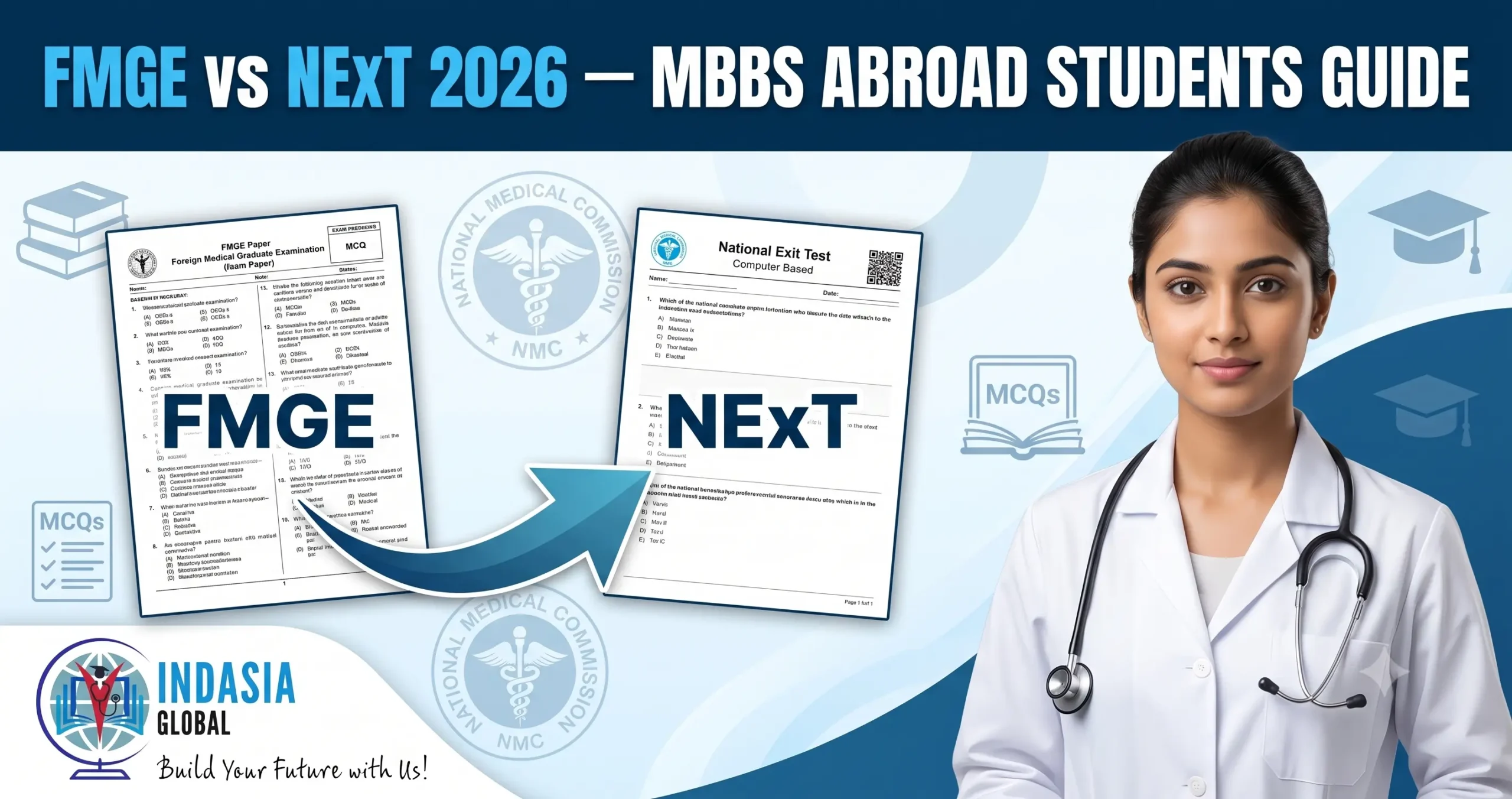
FMGE stands for Foreign Medical Graduate Examination. It was the licensing test that all Indian students who completed MBBS abroad had to clear before they could register as doctors in India. FMGE was conducted by NBEMS — the National Board of Examinations in Medical Sciences.
The pass rate for FMGE was consistently low — typically 15 to 25 percent nationally across all foreign medical graduates. This meant that for every 100 students who returned to India after completing MBBS abroad, only 15 to 25 cleared the exam in the first attempt. The exam had 300 MCQ questions across all medical subjects, with a 2-hour time limit and 150 marks required to pass.
FMGE is now being formally replaced by NExT — the National Exit Test.
What Is NExT and How Is It Different
NExT — the National Exit Test — is the new unified licensing exam introduced by NMC under the National Medical Commission Act 2020. Unlike FMGE, NExT applies to both domestic and foreign medical graduates. Every student who completes MBBS in India or abroad must clear NExT to register and practice medicine in India.
NExT has two parts. NExT Step 1 is a theory-based exam covering all medical subjects in MCQ format — similar to FMGE in structure but expected to be more comprehensive. NExT Step 2 is a clinical and practical skills assessment that FMGE did not have. This is the significant addition — students must demonstrate clinical competence, not just theoretical knowledge.
For MBBS abroad students, this means the university they attend needs to provide genuine, hands-on clinical training from the early years of the program — not just theoretical exposure with minimal patient interaction. Universities that produce high FMGE pass rates generally achieve this through strong clinical training, and these are likely to produce strong NExT Step 2 outcomes as well.
Current Status — Is NExT Live or Is FMGE Still Running
This is the most common question families ask, and the answer is important. NExT is being implemented in phases. As of 2026, the transition is still in progress. Students who completed MBBS abroad in recent years are still appearing for FMGE until NExT is fully implemented.
Students who enroll in MBBS abroad in 2026 will most likely face NExT Step 1 and Step 2 when they return in 2032. By that time, the transition is expected to be complete. However, exact timelines should be verified with NMC directly at nmc.org.in as implementation dates have shifted previously.
Why University Selection Matters More Under NExT
Under FMGE, the exam was entirely theoretical — 300 MCQs, 2 hours, pass or fail. A student from any university could theoretically prepare for FMGE independently through coaching, regardless of how good or poor their clinical training was.
NExT Step 2 changes this. A student who spent 3 clinical years at a university with weak hospital infrastructure, limited patient access, or poor clinical supervision will face a structural disadvantage in a clinical skills assessment. No amount of last-minute coaching can substitute for 3 years of genuine patient contact and clinical reasoning practice.
This makes university selection under NExT more consequential than it was under FMGE. Universities in Georgia like GAU and BAU, which have consistently delivered strong FMGE outcomes, do so because of strong clinical training — which directly translates to NExT Step 2 readiness. Similarly, KazNMU in Almaty, with its directly owned and attached teaching hospitals, provides better clinical training access than universities that rely on shared affiliated hospitals.
What FMGE Pass Rate Data Tells You About NExT Readiness
Since NExT outcomes for students currently studying are not yet available, FMGE pass rate remains the best available proxy for which universities prepare students well for licensing exams.
Universities with consistently high FMGE pass rates — GAU Georgia at 80 percent, BAU Georgia at 63 percent, Al-Farabi Kazakhstan at 51 percent, Astana Medical University Kazakhstan at 35 percent — achieve these rates because their curriculum, clinical training, and faculty are genuinely preparing students for licensing exams, not just graduating them.
Universities with FMGE pass rates below 15 percent are structurally not preparing students adequately. This is a data signal, not a speculation. When evaluating any university for MBBS abroad, always ask for its specific FMGE pass rate for 2023 and 2024, not the country average.
Practical Preparation Strategy for Rajasthan Students
Students enrolled in MBBS abroad should begin NExT preparation from Year 4, not in their final year. The subjects that require the most preparation — Medicine, Surgery, Gynecology, and Pediatrics — are clinical subjects covered in Years 3 through 5. Integrating licensing exam preparation with clinical training from Year 4 produces significantly better outcomes than starting after graduation.
Students in Kazakhstan, Russia, and Georgia have access to FMGE and NExT coaching programs both in-country and through online Indian coaching platforms. Indasia Global advises all our students on preparation strategy from Year 3 onward — not just at the point of application.
Frequently Asked Questions
1. Has FMGE been officially replaced by NExT in 2026? The transition is in progress. Students currently completing MBBS abroad are still appearing for FMGE in the transitional period. Students enrolling in 2026 are expected to face NExT when they return in 2032. Verify current status at nmc.org.in.
2. Is NExT harder than FMGE? NExT is expected to be more comprehensive — it includes a clinical skills assessment (Step 2) that FMGE did not have. However, students who receive genuine clinical training from good universities should be better prepared for NExT than for FMGE, because NExT rewards clinical competence rather than just exam technique.
3. Do both MBBS India graduates and MBBS abroad graduates need to clear NExT? Yes. NExT applies to both domestic and foreign medical graduates. This is a unification — domestic and foreign graduates now face the same licensing exam, which levels the playing field.
4. Which MBBS abroad countries produce the best NExT-ready graduates based on FMGE data? Georgia is the strongest — GAU at 80 percent FMGE in 2024 is the best proxy for NExT Step 1 readiness. Kazakhstan’s Al-Farabi at 51 percent is the second-best in the Central Asian region. Russia’s top universities at 29 to 30 percent nationally perform above average.
5. Can I appear for FMGE or NExT without completing internship? No. Internship completion is mandatory before appearing for FMGE or NExT Step 2. Students must complete the full 6-year program including internship at their foreign university before becoming eligible for the licensing exam.
6. Does Indasia Global help students with NExT preparation planning? We advise students on preparation strategy from Year 3 onward, not just at the application stage. For students in Kazakhstan, our Almaty team can connect students with coaching resources in the country itself.
Still deciding which country for MBBS abroad based on NExT readiness? Contact Indasia Global for a data-backed comparison at our Jaipur office. We guide you based on FMGE data — Kazakhstan, Georgia, Russia — not on which country pays us more.