A significant regulatory change is on the table at India’s National Medical Commission. A formal proposal has been submitted to replace the current percentile-based NEET-UG qualifying system with a fixed percentage cutoff based on actual marks out of 720. If implemented, this change would fundamentally alter how Indian students qualify for MBBS — both in India and abroad.
This guide explains exactly what the proposed change means, how it would affect MBBS abroad eligibility, and what Rajasthan students planning for the 2026-27 intake need to do right now.
What Is the Current NEET Percentile System?
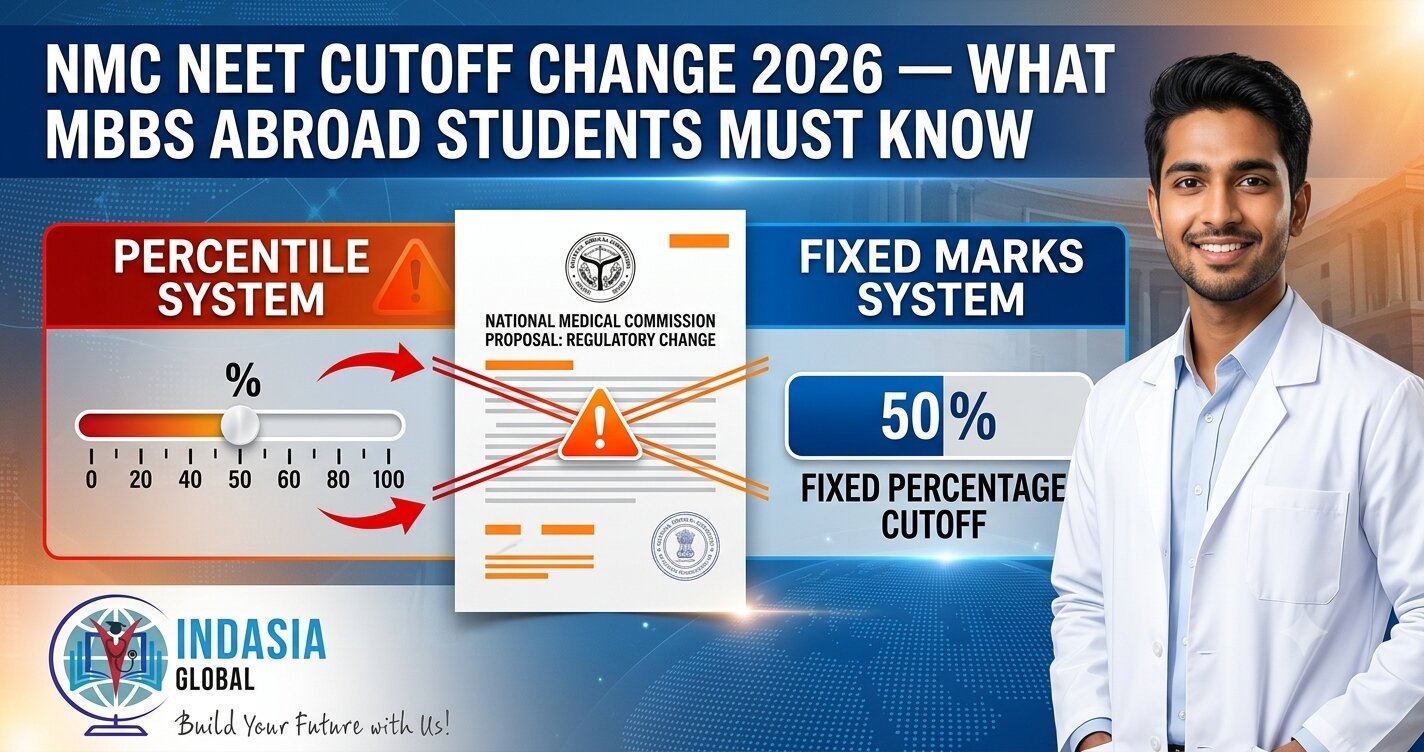
Under the current system, NEET-UG qualifying cutoffs are set as percentiles — not fixed marks. The 50th percentile for General category means that a student must score higher than 50 percent of all candidates who appeared for NEET in that year.
The problem with this system is that the actual marks required change every year based on how the entire cohort performs. In a year where the overall paper is harder, a lower raw score may be enough to clear the 50th percentile. In an easier year, a higher score is needed. This variability creates uncertainty for students and institutions alike.
For MBBS abroad specifically, the NMC has linked the qualifying cutoff for the NMC Eligibility Certificate to this percentile threshold — 50th percentile for General category, 40th for OBC and SC and ST, and 45th for Persons with Disability.
What Is the Proposed Change?
<cite index=”20-1″>The National Medical Commission is considering a major change to how students qualify for NEET-UG. Instead of the current percentile system, a fixed percentage of marks may decide who gets to compete for an MBBS or BDS seat. A formal proposal has been submitted to the NMC to replace the percentile-based NEET-UG qualifying system with a fixed percentage cutoff based on marks out of 720.</cite>
Under the proposed system, a fixed mark threshold — for example, 50 percent of 720, which is 360 marks — would be required regardless of how other candidates performed. The exact cutoff figure has not been declared yet, but <cite index=”26-1″>the proposal suggests replacing the current percentile-based system with a percentage-based system to improve the quality of students entering medical colleges.</cite>
How Does This Affect MBBS Abroad Students?
The impact of this change on MBBS abroad aspirants depends entirely on where the fixed cutoff is set. Here are the two scenarios families need to understand.
Scenario A — Fixed Cutoff Set at a Lower Threshold Than Current Percentile
If the fixed cutoff is set at, say, 40 percent of 720 (approximately 288 marks), and the current 50th percentile happens to require 350 marks in a given year, then more students would qualify for MBBS abroad — not fewer. In this scenario, the change is beneficial for students who scored in the 290 to 349 range.
Scenario B — Fixed Cutoff Set Higher Than Current Percentile
If the fixed cutoff is set at 50 percent of 720 (360 marks) while the current 50th percentile requires only 137 to 145 marks, then a very large number of students who currently qualify for MBBS abroad would lose eligibility. This is the scenario that has concerned students and families the most.
The NMC has not yet announced the proposed fixed cutoff percentage. <cite index=”20-1″>The NMC NEET-UG reform is still under consideration.</cite> No formal notification implementing the change has been issued as of October 2026. The current percentile system remains in effect.
What Students Must Do Right Now — Practical Advice
Because the proposed change is not yet implemented, students who have cleared NEET under the current percentile system are safe for the 2026-27 intake. However, several action points are urgent.
First, use your current valid NEET score before any change takes effect. If your NEET score from 2024, 2025, or 2026 meets the current qualifying percentile threshold, you are eligible for MBBS abroad under the rules that apply right now. Waiting to see how this regulatory change resolves could mean missing the 2026-27 intake window.
Second, note the 36-month validity rule. Your NEET score is valid for three years from the date of result declaration. Students with NEET 2024 results have until 2027. Students with NEET 2023 results have an extremely narrow window. If any regulatory change is implemented for NEET 2027 onward, your existing valid score would still have been earned under the old system — but NMC’s exact position on grandfathering will depend on how the notification is worded.
Third, apply for the NMC Eligibility Certificate immediately under the current rules. This certificate confirms your eligibility for foreign MBBS admission. Once issued under the current percentile framework, it provides a documented record of your eligibility at the time of application.
What Actually Changed in NMC’s June 2026 Update
It is important to distinguish between the proposed percentile-to-percentage change (which is still under consideration) and the actual June 2026 NMC clarification (which has been implemented).
<cite index=”27-1″>The June 2026 clarification did not replace the core regulations with a completely new admission system. The main framework remains the Foreign Medical Graduate Licentiate Regulations 2021. The main 2026 updates addressed physical compensation, evidence and existing foreign medical students.</cite>
The June 2026 update specifically addressed students who had completed portions of their education online during the pandemic years and provided relief from additional compensation requirements. It did not change the NEET qualifying threshold or the eligibility criteria for new MBBS abroad admissions.
What Indasia Global Advises for Rajasthan Students in October 2026
At Indasia Global’s Jaipur office, we are monitoring this regulatory development closely. Our recommendation to every Rajasthan student and family who contacts us is consistent: do not wait for regulatory uncertainty to resolve before acting on a valid NEET score.
The 2026-27 intake window for Kazakhstan, Russia, Georgia, and Uzbekistan is closing in October and November 2026. Universities like KazNMU and Al-Farabi Kazakh National University in Almaty have limited seats, and our resident Almaty team — headed by Dr. Tara Chand Nehra who has been in Kazakhstan since 1996 — is already coordinating final enrollment for this session.
If you have a valid NEET score that meets the current qualifying threshold, the right time to act is now.
Frequently Asked Questions
1. Has NMC officially replaced the NEET percentile system with fixed marks? No. As of October 2026, the proposed change is still under consideration. A formal proposal has been submitted but no implementation notification has been issued. The current percentile system remains in effect for MBBS abroad admissions.
2. What is the current minimum NEET score required for MBBS abroad? Under the current system, General category students need to clear the 50th percentile — approximately 137 to 145 marks in recent years. OBC, SC, and ST students need the 40th percentile — approximately 107 to 113 marks. These are percentile-based thresholds that vary slightly each year.
3. If the fixed cutoff is introduced, will students who already have a valid NEET score be affected? This depends on how the NMC notification is worded if and when it is implemented. Students currently holding a valid NMC Eligibility Certificate issued under the existing rules would be in a stronger position. This is another reason to apply for the Eligibility Certificate immediately under current rules.
4. Should I wait to see how the NEET cutoff change resolves before applying for MBBS abroad? No. The 2026-27 intake window is open now. Waiting for regulatory clarity could mean missing this year’s admission cycle entirely. Apply under the current valid rules and monitor any changes for future planning.
5. Does the proposed change affect students already studying MBBS abroad? No. The proposed change, if implemented, would affect new admission eligibility from the batch it is introduced. Students currently enrolled at NMC-approved foreign universities are governed by the rules that applied at the time of their admission.
6. Where can I track the latest NMC update on this proposed change? Monitor nmc.org.in directly for any official notification. Do not rely on third-party websites or social media for regulatory updates — always verify at the official NMC source.
Holding a valid NEET 2024, 2025, or 2026 score and concerned about regulatory changes? Contact Indasia Global for an immediate assessment at our Jaipur office. We will confirm your current eligibility and help you secure admission at KazNMU or Al-Farabi in Kazakhstan, Russia, Georgia or Uzbekistan before the 2026-27 window closes.