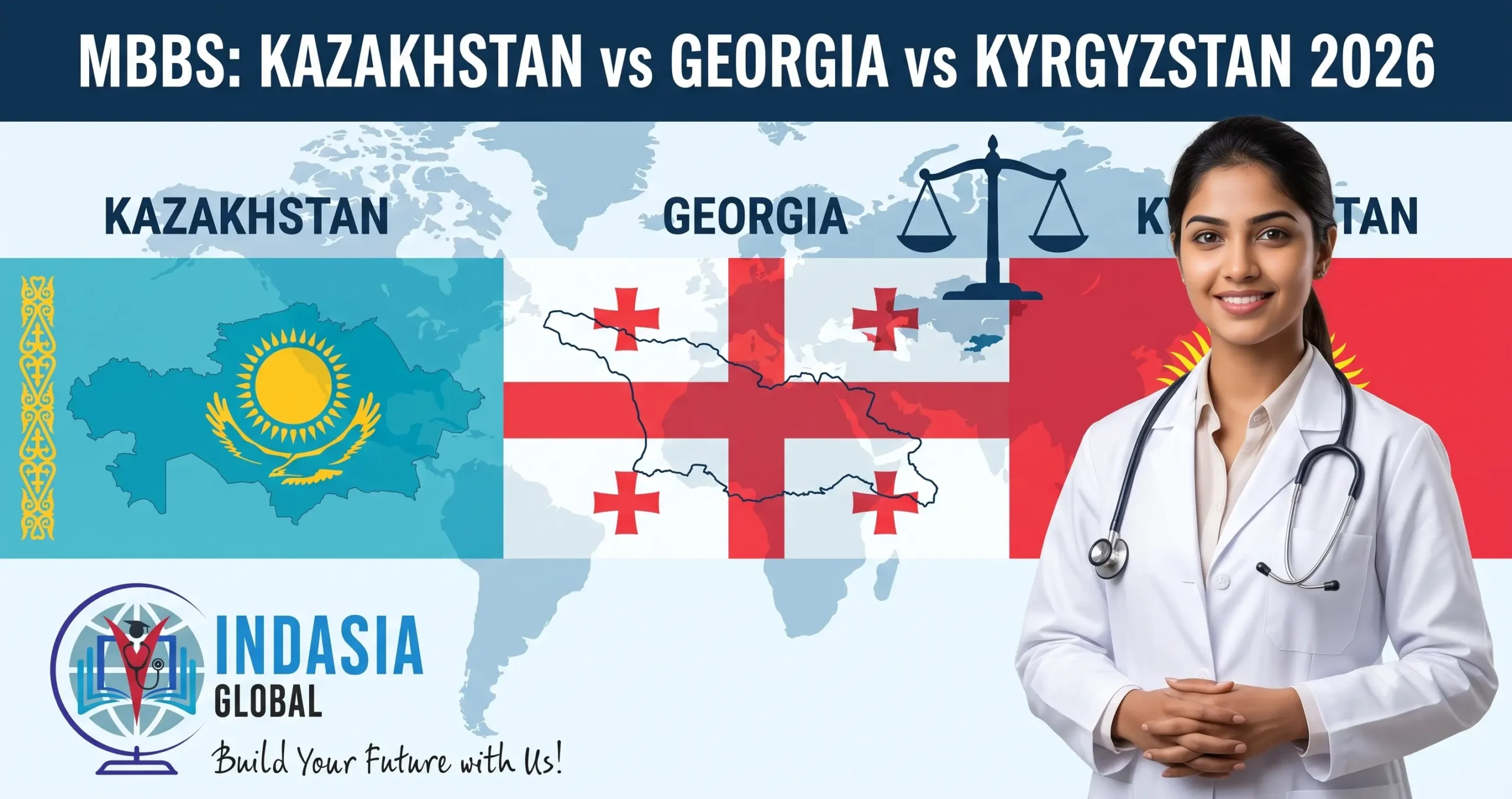
If you are an Indian student or parent comparing MBBS abroad options in 2026, Kazakhstan, Georgia, and Kyrgyzstan are three of the most frequently searched destinations. All three are NMC-compliant options offering English-medium MBBS programs. But they differ significantly in fees, FMGE pass rates, clinical exposure, and daily life experience. This guide gives you an honest, data-backed comparison across every factor that actually matters for your career.
The One Number Every Parent Must Know First: FMGE Pass Rate
Before comparing fees, consider what happens after your child completes MBBS abroad. To practice medicine in India, foreign medical graduates must clear the FMGE (being replaced by NExT). Here is the verified 2024 FMGE pass rate data from NBEMS for these three countries.
Georgia: 35 to 45 percent — The highest FMGE pass rate among all Central Asian and European MBBS destinations. Georgian American University achieved 80.33 percent in 2024, the highest among any major university globally. BAU International University achieved 63.29 percent.
Kazakhstan: 20 to 30 percent — Mid-range performance. Al-Farabi Kazakh National University achieved 51.08 percent, and Astana Medical University achieved 35.90 percent in 2024. KazNMU’s country-wide average is approximately 25 percent, which is above the global average for foreign medical graduates.
Kyrgyzstan: 15 to 25 percent — The lowest of the three, though I.K. Akhunbaev Kyrgyz State Medical Academy recorded 31.56 percent, which is above the country average.
The FMGE pass rate is not just a number. It directly reflects how well the university’s curriculum prepares Indian students for licensing exams. A 10 percent difference in pass rate can mean the difference between practicing medicine in India within 8 years or spending additional years in preparation and re-attempts.
Total Cost Comparison for 6-Year MBBS (Verified 2026 Data)
Georgia: Rs 37 to 56 lakhs total — Higher tuition, higher cost of living at Rs 15,000 to 22,000 per month, but significantly better FMGE outcomes justify the premium for many families.
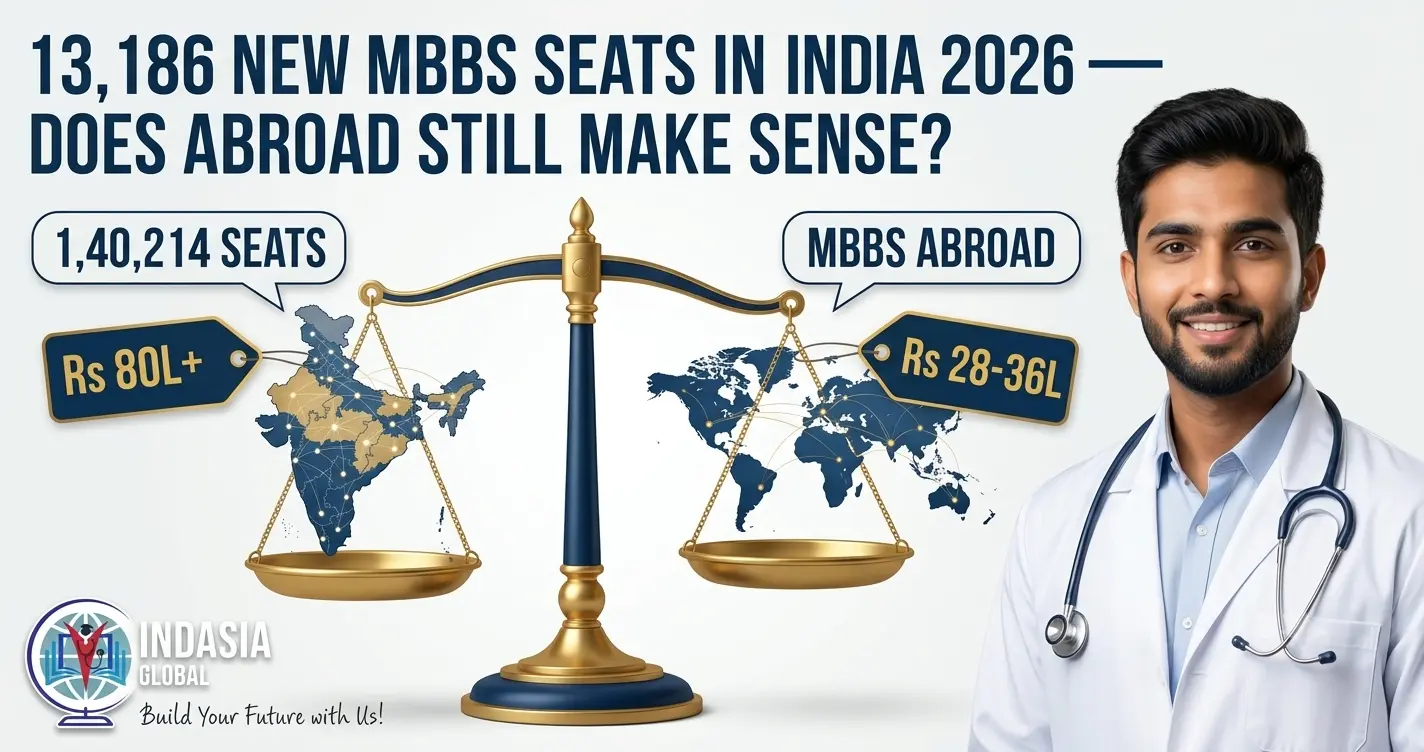
Kazakhstan: Rs 28 to 36 lakhs total — Mid-range cost with tuition at Rs 3.5 to 6 lakhs per year, hostel and food at Rs 12,000 to 18,000 per month. Strong NMC-compliant universities, particularly in Almaty.
Kyrgyzstan: Rs 17 to 28 lakhs total — The most affordable option, with tuition starting at Rs 2 to 3 lakhs per year. The lowest cost of living in the comparison, but the trade-off is weaker clinical infrastructure in most universities and the lowest FMGE outcomes.
University Quality and Clinical Exposure
Georgia has European-standard medical universities with strong hospital infrastructure in Tbilisi and Batumi. Clinical training is fully in English, which directly contributes to the higher FMGE outcomes. Students get strong hands-on exposure from Year 3 onward.
Kazakhstan has the oldest medical universities in Central Asia. KazNMU was founded in 1930 and is the most established institution in the region. Al-Farabi Kazakh National University is among the world’s top 200 universities. Clinical exposure is solid, and Almaty is a major city with well-equipped teaching hospitals. Indasia Global’s resident team in Almaty provides direct student support throughout the degree.
Kyrgyzstan has NMC-approved universities, but clinical infrastructure is weaker in most institutions compared to Kazakhstan and Georgia. Teaching hospital quality varies significantly across the smaller cities where most Kyrgyzstan universities are based.
Safety, Indian Community, and Student Life
Georgia — Tbilisi and Batumi are modern European cities. Safety standards are high, and Georgian culture is warm toward international students. The Indian community is growing, with Indian food and cultural events available in major student cities.
Kazakhstan — Almaty is the most developed city in Central Asia. A large, well-established Indian student community has existed here since the early 1990s. Indian grocery stores, Indian mess facilities, and cultural organizations make daily life significantly easier. Dr. Tara Chand Nehra, who heads Indasia Global’s Almaty team, has lived in Kazakhstan since 1996 and provides 24-hour support as a guardian.
Kyrgyzstan — Bishkek has a developing Indian student community. Infrastructure and daily life quality are more limited compared to Almaty and Tbilisi. Winters are harsh, with temperatures dropping significantly below zero.
Eligibility and Admission Process
All three countries require the same NMC baseline eligibility for Indian students — NEET qualification, minimum 50 percent aggregate in Physics, Chemistry, and Biology in Class 12, and a minimum age of 17 years. The admission process is similar across all three, with document submission followed by an invitation letter and student visa application.
Honest Recommendation Based on Your Profile
Choose Georgia if: FMGE pass rate is your top priority, you want European-standard clinical training and global recognition, and your budget allows Rs 37 to 56 lakhs total.
Choose Kazakhstan if: You want a strong balance of cost and quality, need on-ground Indian support in the destination city, and your budget is Rs 28 to 36 lakhs. Prioritize KazNMU or Al-Farabi for the best outcomes within Kazakhstan.
Choose Kyrgyzstan if: Budget is the primary constraint and you are comfortable with a lower FMGE average, accepting that additional post-graduation preparation will be essential before the licensing exam.
Do not make the decision based on fees alone. A student who spends Rs 10 lakhs less on tuition but spends 3 additional years failing FMGE has not saved money. University-specific data matters more than country averages — always ask for the university’s individual FMGE pass rate, not just the national figure.
Frequently Asked Questions
1. Which country has the best FMGE pass rate among Kazakhstan, Georgia, and Kyrgyzstan? Georgia has the highest FMGE pass rate at 35 to 45 percent country-wide, with top universities like Georgian American University achieving over 80 percent. Kazakhstan is second at 20 to 30 percent, and Kyrgyzstan is third at 15 to 25 percent.
2. Is MBBS in Georgia worth the higher fees compared to Kazakhstan? If FMGE performance is a priority, the premium for Georgia is justified. Georgia’s top universities consistently produce better licensing exam outcomes. For families with a tighter budget, Kazakhstan with the right university selection provides a strong alternative.
3. Why is Kyrgyzstan cheaper than Kazakhstan and Georgia? Lower cost of living, weaker clinical infrastructure in most universities, and earlier-stage medical education development compared to Kazakhstan and Georgia. The trade-off is reflected in the lower FMGE outcomes.
4. Which country is safest for Indian female students? All three countries are considered relatively safe. Georgia and Kazakhstan’s major cities — Tbilisi, Almaty, Nur-Sultan — have established international student communities and lower crime rates. Almaty in particular has a very large Indian student presence which provides a strong peer support network.
5. Can I complete MBBS in less than 6 years in any of these countries? No. NMC’s FMGL Regulations 2021 require a minimum of 54 months of education at a single institution. Any program offering MBBS in less than this duration is not compliant and the degree will not be recognized in India.
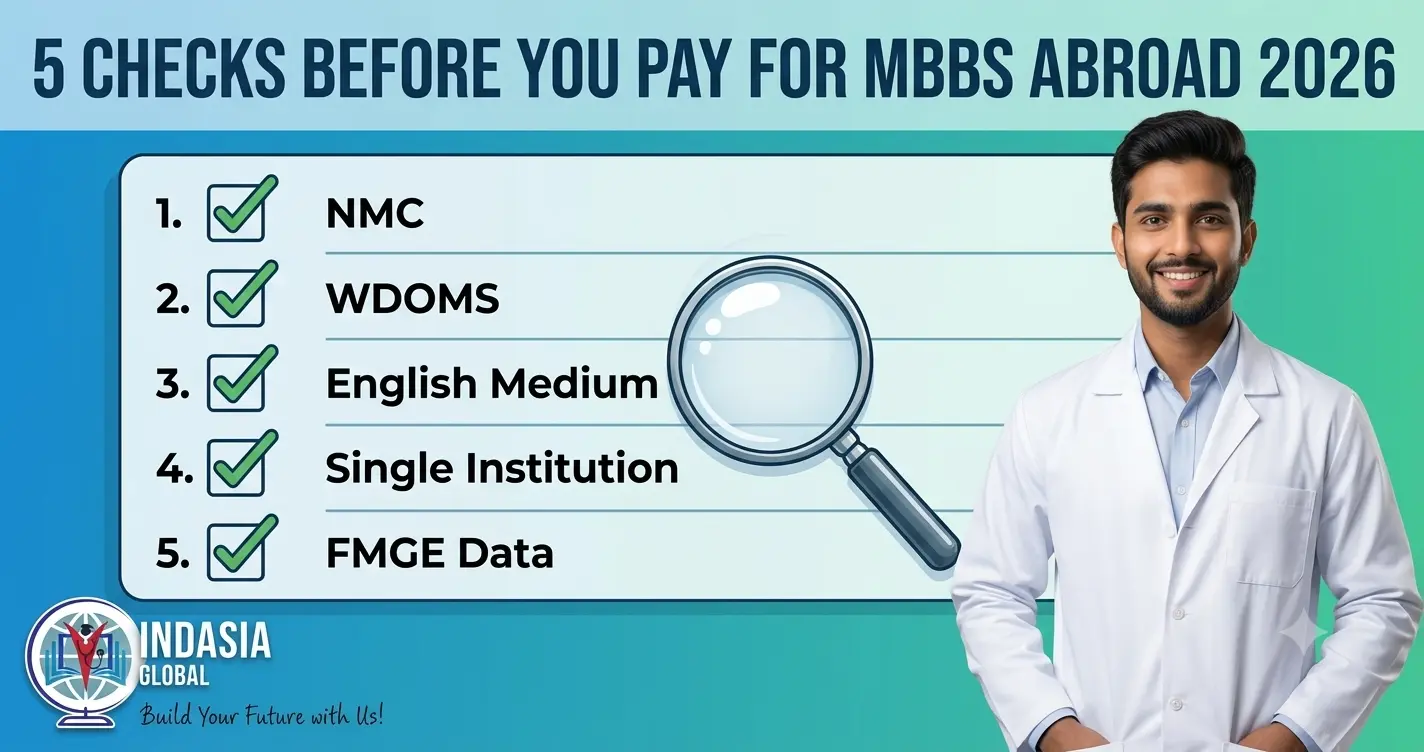
6. How do I verify that a university in Kazakhstan, Georgia, or Kyrgyzstan is NMC compliant? Visit nmc.org.in and cross-check the university against the World Directory of Medical Schools at wdoms.org. Both checks must confirm the university before you make any payment.
For personalized guidance on choosing between Kazakhstan, Georgia, and Kyrgyzstan based on your NEET score and budget, contact Indasia Global for free counselling. Our team has direct on-ground experience in Kazakhstan and can help you make an informed, data-backed decision.