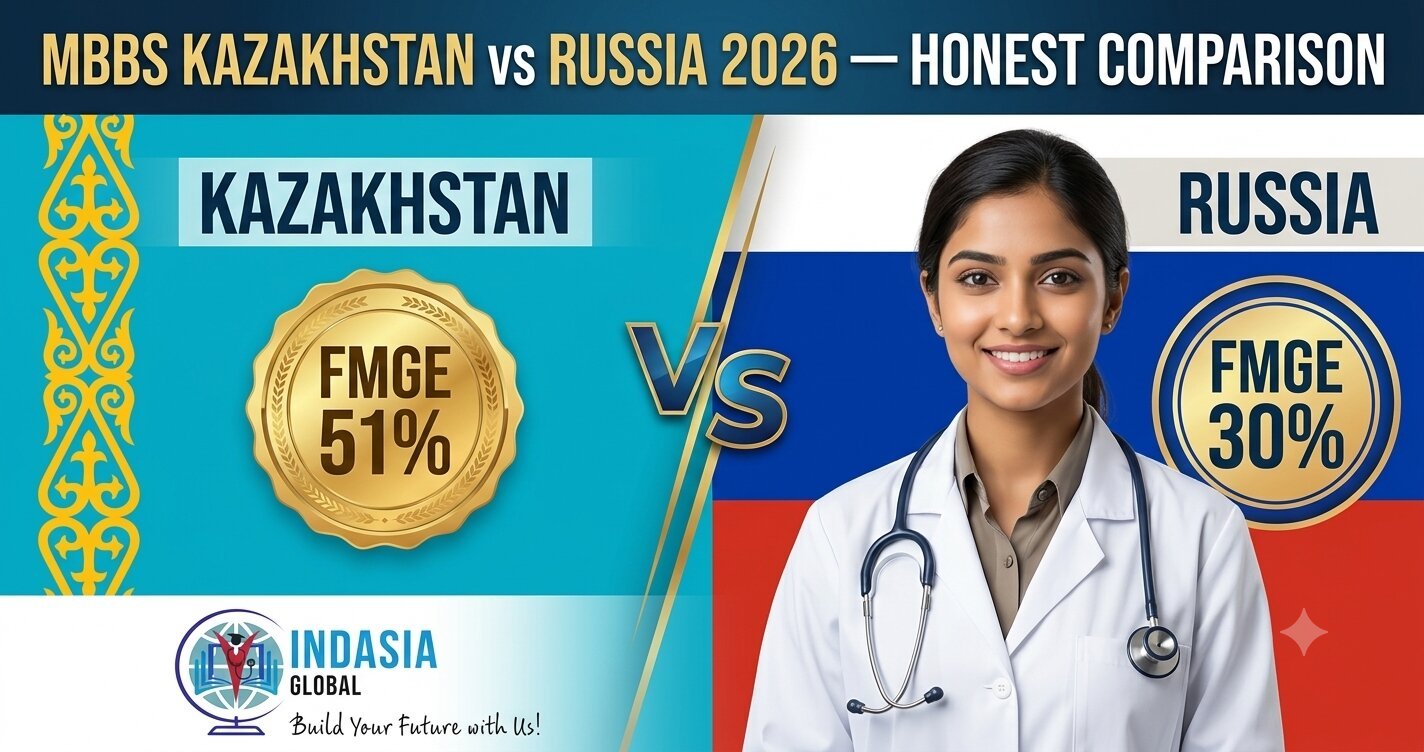
Kazakhstan and Russia are the two most popular MBBS abroad destinations for Indian students after Georgia’s state university ban changed the landscape in 2026. Both are NMC-approved options. Both have large Indian student communities. Both are significantly more affordable than Indian private medical colleges.
But they are not the same — and choosing between them based on vague impressions or a consultant’s commission preference rather than verified data is one of the most avoidable mistakes families make.
This guide gives you the honest, data-backed comparison across every factor that actually matters — FMGE outcomes, fees, English medium compliance, clinical training, student life, and the one factor that makes Kazakhstan uniquely better supported for Jaipur families.
The One Number to Start With — FMGE 2024 Data
Before comparing anything else, compare the licensing exam outcomes. This is the number that determines whether your child’s 6-year investment produces a practicing doctor in India.
Kazakhstan’s best university — Al-Farabi Kazakh National University in Almaty — recorded a 51.08 percent FMGE pass rate in 2024. Astana Medical University recorded 35.90 percent. KazNMU — the oldest medical university in Central Asia and the institution our own Dr. Tara Chand Nehra graduated from — performs consistently above Kazakhstan’s national average of approximately 25 percent.
Russia’s national FMGE average was approximately 29 to 30 percent in 2024 — above the global average of 20 to 23 percent and comparable to Kazakhstan’s national figure. Russia’s top performers — Kazan Federal University, Bashkir State Medical University, and Rostov State Medical University — consistently perform above this national average.
Summary: At the top university level, Kazakhstan’s best (51 percent at Al-Farabi) outperforms Russia’s best performers. At the national average level, Russia (29-30 percent) and Kazakhstan (25 percent) are comparable.
Fee Comparison — Verified 2026 Data
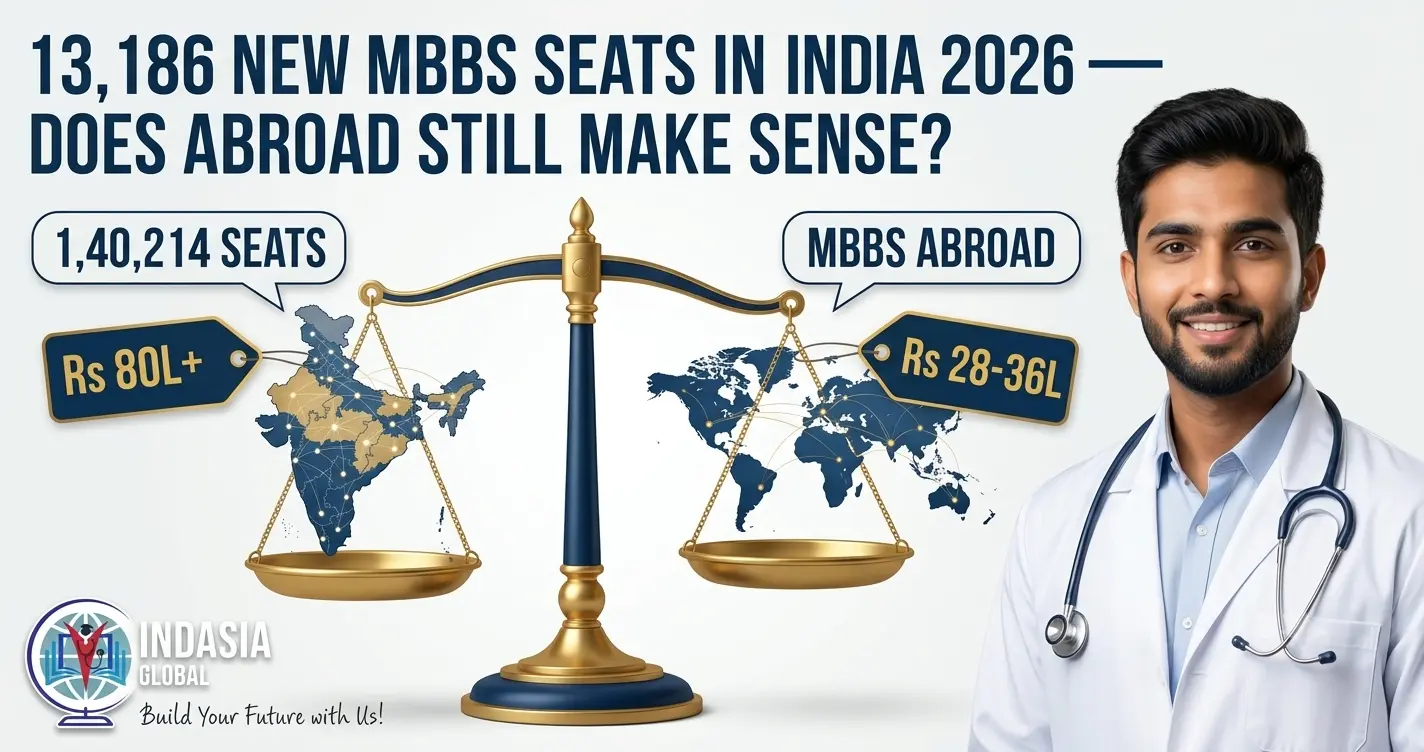
Kazakhstan (Almaty universities): Annual tuition: ₹3.5 to ₹6 lakhs Total 6-year cost including hostel, food, and living: ₹28 to ₹36 lakhs
Russia (varies significantly by city): Annual tuition at Moscow and St. Petersburg universities: ₹4 to ₹7 lakhs Annual tuition at Siberian and Ural cities (Kazan, Ufa, Novosibirsk, Perm): ₹2.5 to ₹4 lakhs Total 6-year cost at affordable Russian cities: ₹30 to ₹40 lakhs Total 6-year cost at Moscow or St. Petersburg: ₹45 to ₹60 lakhs
Verdict: For comparable quality universities, Kazakhstan and Russia are in a similar price band — ₹28 to ₹40 lakhs. However, Kazakhstan’s cost range is more consistent and predictable. Russia has more variation — choosing the wrong Russian city or university can push total cost toward ₹50 to 60 lakhs, while the cheapest options may compromise on quality.
English Medium — The Critical 2026 Difference
This is where Kazakhstan has a clear structural advantage in 2026.
(cite index=”2-1″>The NMC has updated rules for MBBS abroad. The medium of instruction for MBBS programs must be English for graduates to be eligible for NExT and practice in India.</cite>
Kazakhstan’s NMC-approved universities — KazNMU, Al-Farabi, Astana Medical University — have long-established English-medium programs as their standard for international students. This is not a recent adaptation; it has been the norm for 20 to 30 years. When students in Almaty attend clinical rotations, the formal teaching, case presentations, and assessments are conducted in English.
Russia presents a more complex picture. Many Russian universities have historically offered MBBS in a bilingual format — English for theory years, transitioning to Russian during clinical rotations when patient interactions require Russian-language proficiency. The NMC’s April 2026 clarification has brought this distinction into sharp relief.
Before choosing any Russian university, families must ask specifically whether the entire 6-year program — including clinical rotations in Years 3 through 6 — is conducted in English. Get this confirmation in writing. Universities that describe their program as “English with Russian for clinicals” may not meet NMC’s full English-medium requirement.
Verdict: Kazakhstan has a clear advantage on English medium compliance in 2026. Russia requires more careful university-level verification.
University Quality and Clinical Infrastructure
Kazakhstan: KazNMU, founded in 1930, is the oldest medical university in Central Asia and owns three teaching hospitals directly attached to its campus. Clinical training from Year 3 onward is structured and consistent because the hospitals are university-managed. Al-Farabi Kazakh National University holds a QS world ranking of 163rd globally — the highest-ranked university in Kazakhstan — and recorded 51.08 percent FMGE pass rate in 2024.
Russia: Russia’s top medical universities have strong overall reputations. Kazan Federal University is one of Russia’s oldest and most internationally recognized institutions. Bashkir State Medical University in Ufa has a very large Indian student community and consistent FMGE outcomes. Rostov State Medical University has been a popular choice for Indian students for decades.
Russia offers a wider range of university options than Kazakhstan — over 50 NMC-approved institutions versus approximately 7 in Kazakhstan. This means more choice but also more due diligence required. The quality gap between Russia’s best and worst options is larger than the gap within Kazakhstan’s limited set of NMC-approved universities.
Verdict: Kazakhstan wins on consistency and predictability. Russia offers more options but requires more careful university-level research.
Student Life — Indian Community, Food, Safety
Kazakhstan — Almaty: Almaty has the largest and most established Indian student community in Central Asia. Indian mess facilities have existed for over 20 years. Indian grocery stores, cultural organizations, and peer networks are well-developed. The city is modern, safe, and well-connected to India by air.
Climate: Summers up to 32 degrees Celsius, winters around minus 10 to minus 15 degrees Celsius — milder than most Russian cities.
Russia — varies by city: Russia’s Indian student community is distributed across many cities — Kazan, Ufa, Novosibirsk, Krasnodar, and others. Major student cities have Indian communities and some Indian food options, but the infrastructure is less consolidated than Almaty’s.
Climate: Significantly colder than Kazakhstan in most cities. Siberian cities like Novosibirsk see minus 20 to minus 30 degrees Celsius winters. Kazan and Ufa are more moderate — similar to Almaty in winter temperature.
Verdict: Kazakhstan (Almaty specifically) wins on student community infrastructure and climate. Russia’s experience varies significantly by city.
The Factor That Makes Kazakhstan Uniquely Better for Jaipur Families
No comparison of Kazakhstan versus Russia for Jaipur families is complete without mentioning a factor that no fee table or FMGE chart captures: Indasia Global’s resident team in Almaty.
Dr. Tara Chand Nehra has been living in Almaty, Kazakhstan since 1996. He completed his own MD from KazNMU — the same university we most frequently recommend to families. He served as President of the Indian Chamber of Commerce and Culture in Kazakhstan from 2017 to 2019. He knows KazNMU’s faculty personally. He knows the hostel system. He knows the hospitals. He knows the city.
When a family from Jaipur sends their child to Almaty through Indasia Global, Dr. Nehra’s team coordinates airport pickup, hostel registration, university enrollment, and ongoing student support from Day 1. For Russia, Indasia Global provides counselling and admission assistance — but we do not have a resident team physically present in any Russian city.
This is not a minor difference. For families sending a child abroad for the first time, knowing there is a trusted, experienced Indian doctor physically present in the destination city — not reachable only through a WhatsApp call from Jaipur — changes the nature of the decision entirely.
Side-by-Side Summary
| Factor | Kazakhstan (Almaty) | Russia (top cities) |
|---|---|---|
| Best FMGE Pass Rate 2024 | 51.08% (Al-Farabi) | ~30% (Kazan, Bashkir) |
| National FMGE Average | ~25% | ~29-30% |
| Total 6-Year Cost | ₹28-36 Lakhs | ₹30-48 Lakhs |
| English Medium Compliance | Strong — established | Needs careful verification |
| University Consistency | High — 7 strong options | Variable — 50+ options |
| Indian Community | Very strong (Almaty) | Good but distributed |
| Winter Climate | Mild (-10 to -15°C) | Colder in most cities |
| On-Ground Support | Indasia Almaty team | General consultancy |
| NMC Advisory Issues | None in 2026 | English medium concerns |
Honest Recommendation
Choose Kazakhstan if: Your priority is predictability — a consistent, well-verified MBBS program at an NMC-compliant university with strong FMGE data, an established Indian community, and on-ground support from a consultancy that has been physically present in Almaty for nearly 30 years. Budget: ₹28-36 lakhs.
Choose Russia if: You have a specific preference for Russia and have done careful university-level research to confirm full English-medium instruction, NMC compliance, and FMGE outcomes at the specific institution you are considering. Budget: ₹30-48 lakhs depending on city.
For Jaipur and Rajasthan families considering either option, a free counselling session at Indasia Global’s Jaipur office will give you university-specific FMGE data for both Kazakhstan and Russia and an honest assessment of which is the better fit for your child’s profile and budget.
Frequently Asked Questions
1. Is MBBS in Kazakhstan better than Russia for Indian students in 2026? For most Indian students from Rajasthan, Kazakhstan offers a better combination of predictable English-medium instruction, above-average FMGE outcomes, and on-ground Indian community support in Almaty. Russia has more university options but requires more careful due diligence on English medium compliance after NMC’s April 2026 advisory.
2. Which has better FMGE pass rate — Kazakhstan or Russia? At the top university level, Kazakhstan’s Al-Farabi at 51.08 percent outperforms Russia’s best at approximately 30 percent. At the national average level, Russia (29-30 percent) is slightly above Kazakhstan (25 percent). University-specific data matters more than country averages.
3. Is MBBS in Russia cheaper than Kazakhstan? Comparable. Affordable Russian cities (Kazan, Ufa) offer similar total costs of ₹30-40 lakhs to Kazakhstan’s ₹28-36 lakhs. Moscow and St. Petersburg are significantly more expensive. Kazakhstan’s cost is more predictable regardless of city because all major universities are in Almaty.
4. Does the NMC’s English medium rule affect Russia more than Kazakhstan? Yes. Kazakhstan’s NMC-approved universities have had English-medium programs for international students for decades. Some Russian universities have bilingual programs that may not fully meet NMC’s English-medium requirement. This is the most important due diligence step for Russia in 2026.
5. Does Indasia Global have a team in Russia? Indasia Global provides counselling and admission assistance for Russia from our Jaipur office. However, our resident team is based in Almaty, Kazakhstan — headed by Dr. Tara Chand Nehra who has lived there since 1996. This on-ground Kazakhstan presence is a specific advantage for Kazakhstan-bound students.
6. Can I switch from Russia to Kazakhstan mid-program? No. NMC’s FMGL Regulations 2021 require all 54 months of education at a single institution. A mid-program transfer invalidates NExT eligibility. University selection before admission is the only opportunity to get this right.
Deciding between MBBS in Kazakhstan and Russia and want an honest, data-backed comparison? Contact Indasia Global for free counselling at our Jaipur office. We will give you university-specific FMGE data for both Kazakhstan and Russia and help you decide based on your profile — not on which country pays us more.